Smarter Defect Detection, More Consistent Quality Control and Higher Production Efficiency
In modern manufacturing, quality inspection is becoming an increasingly important part of the production process.
For hardware, automotive components, electronic parts and precision components, manufacturers need to detect defects quickly and consistently while maintaining high production efficiency.
Traditional manual inspection can be useful for certain applications, but it can become challenging when production volumes increase or when products require continuous and detailed inspection.
This is where AI Visual Inspection and Machine Vision Technology are becoming increasingly valuable.
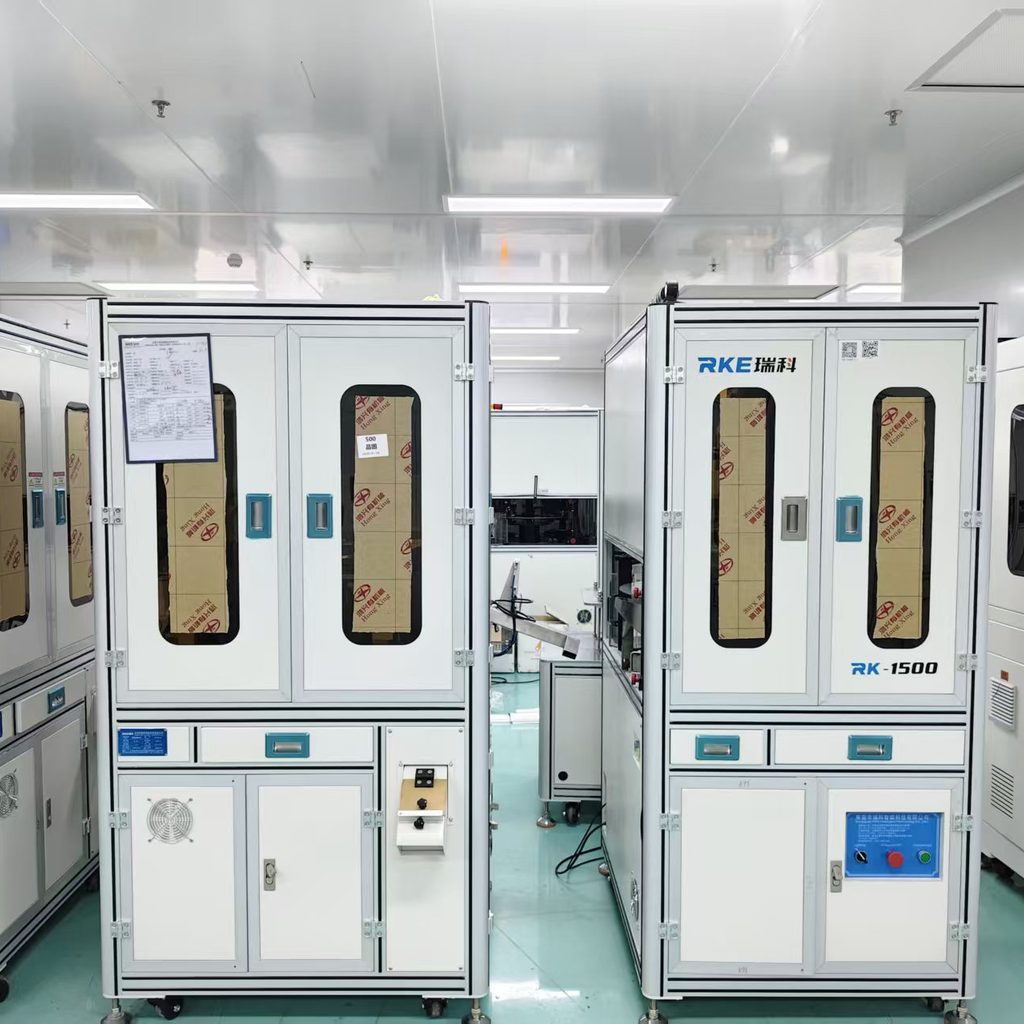
What Is AI Visual Inspection?
AI Visual Inspection combines industrial cameras, lighting systems, image processing and artificial intelligence algorithms to automatically analyze products.
Instead of relying entirely on operators to identify defects, the system captures product images and evaluates them according to predefined inspection requirements.
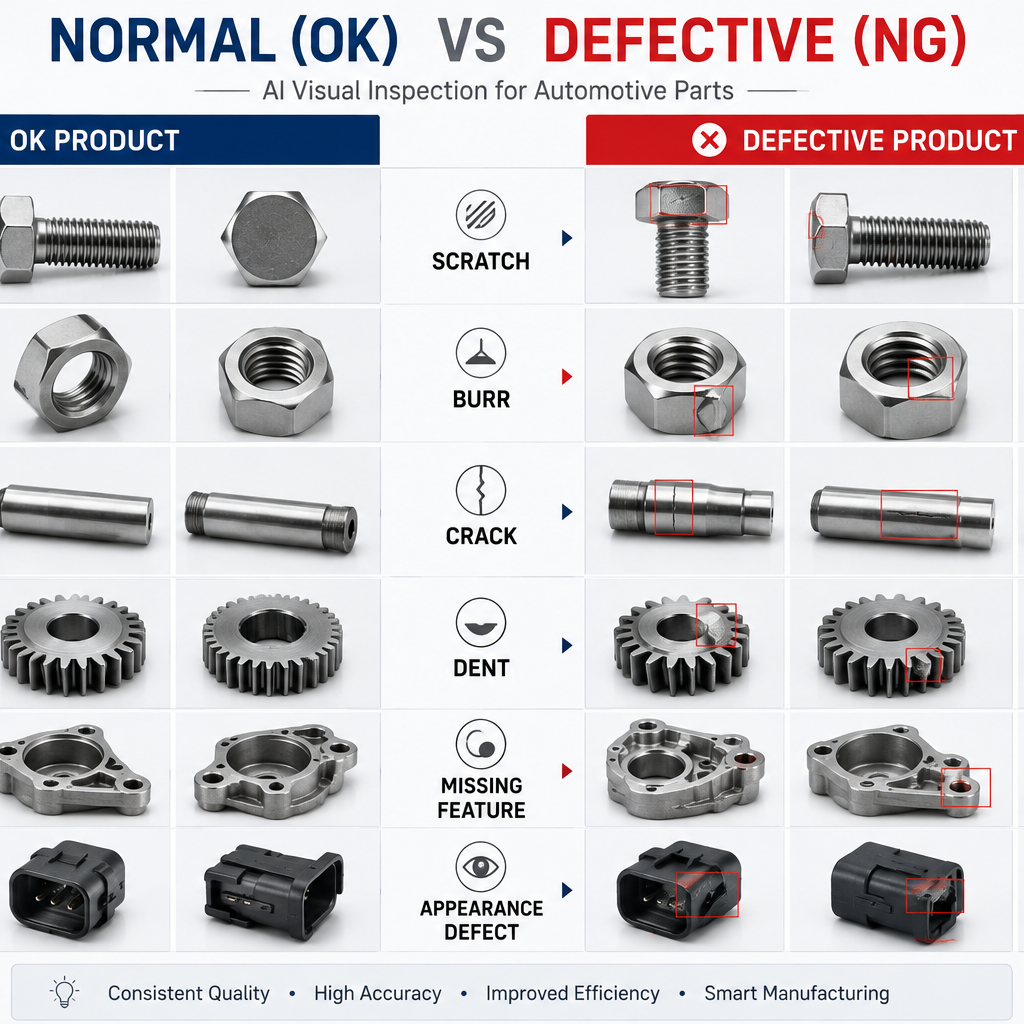
Depending on the application, an AI vision system can be used to inspect characteristics such as:
- Surface defects
- Scratches
- Cracks
- Burrs
- Dents
- Missing features
- Abnormal shapes
- Product appearance
- Specified dimensional characteristics
The inspection method and AI model can be developed according to the actual product and defect requirements.
Why Are Manufacturers Turning to AI Inspection?
1. More Consistent Quality Control
One of the biggest challenges of manual inspection is maintaining consistent judgment over long production periods.
Different operators may have different levels of experience, and repetitive inspection tasks can also lead to fatigue.
An automated AI Inspection System follows defined inspection criteria, helping manufacturers establish a more consistent inspection process.
This is particularly valuable for high-volume production where the same inspection needs to be repeated thousands of times.
2. Detecting Small and Complex Defects
Some product defects are difficult to identify with the naked eye.
Small scratches, surface abnormalities or subtle differences may require close observation and consistent lighting conditions.
With appropriate cameras and lighting, a machine vision system can capture detailed product images.
AI algorithms can then analyze these images and identify predefined defect characteristics.
3. Faster Inspection for High-Volume Production
Production speed is another important factor.
When manufacturers produce large quantities of components, inspecting every product manually can consume considerable time and labor.
Automated visual inspection can work continuously with the production process.
A typical workflow can be:
Feeding → Positioning → Imaging → AI Inspection → OK/NG Sorting
The system can inspect products as they move through the inspection process, helping manufacturers integrate quality control directly into production.
This makes visual inspection not only a quality-control function, but also an important part of production automation.
4. Multiple Inspection Points in One System
Modern products often require more than one inspection point.
For example, a component may need to be checked for:
Appearance
Dimensions
Shape
Contour
Position
Structural Features
Different cameras, lighting systems and inspection technologies can be combined according to the actual application.
This allows manufacturers to build a more comprehensive inspection solution instead of relying on a single inspection point.
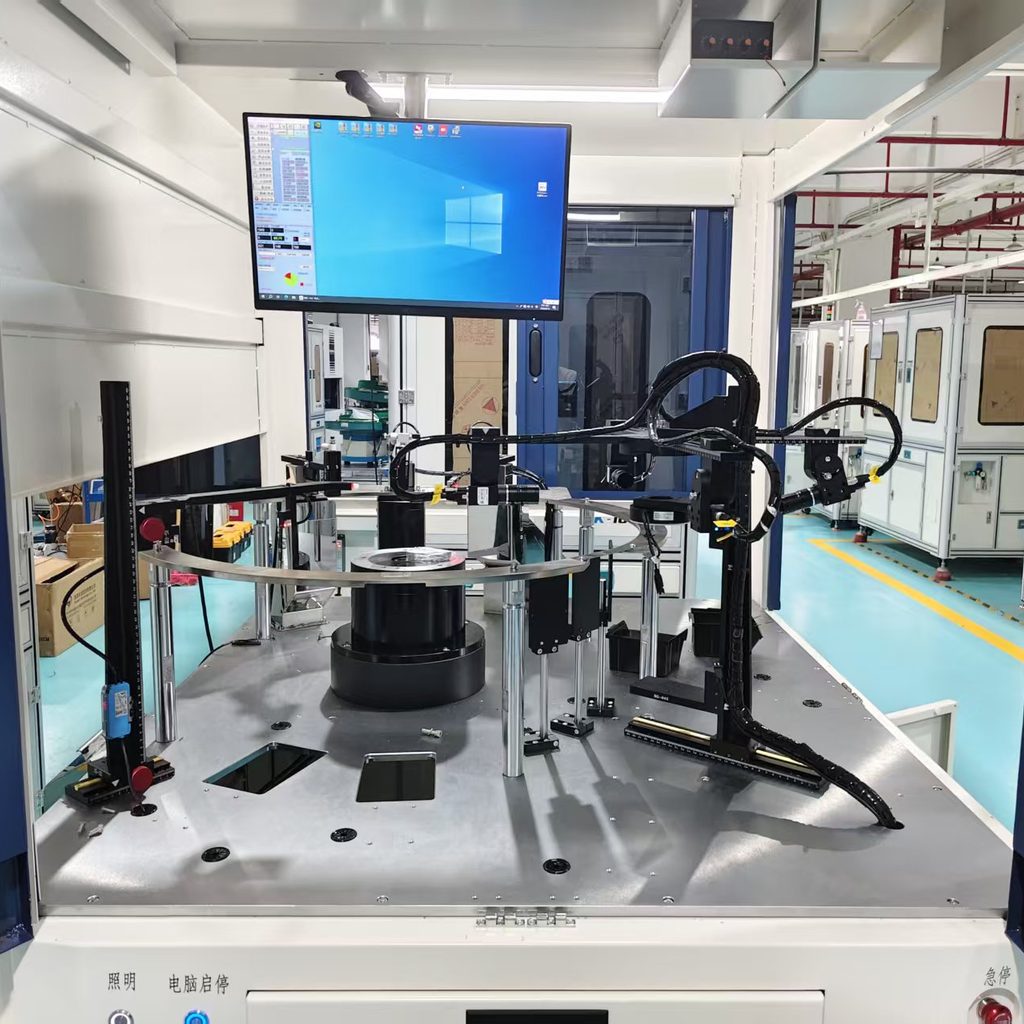
AI Inspection Is More Than Just a Camera
It is important to understand that an automated visual inspection machine is not simply a camera installed beside a production line.
A complete inspection system may involve:
Industrial Cameras
Capture detailed product images.
Lighting Systems
Provide stable and suitable illumination for different surfaces.
Image Processing
Processes and analyzes captured images.
AI Algorithms
Identify predefined product characteristics and defects.
Mechanical Systems
Position and transport products during inspection.
Automation
Connect inspection with feeding, sorting and other production processes.
The cooperation of these components determines the overall performance of the inspection system.
Different Products Require Different Vision Solutions
There is no universal inspection system that can be applied to every product.
A small fastener may require appearance and dimensional inspection.
An automotive component may require contour, surface and structural inspection.
An electronic component may contain very small features that require high-resolution imaging.
A precision component may require measurement with very tight tolerances.
Therefore, the first step in developing a vision inspection solution is always to understand the product.
The key questions include:
What needs to be inspected?
What defects need to be detected?
What is the production speed?
What level of accuracy is required?
How are products fed into the system?
How should NG products be separated?
Only after understanding these requirements can the appropriate inspection technology be selected.
From Visual Inspection to Intelligent Manufacturing
AI visual inspection is also becoming an important part of smart manufacturing.
A modern automated inspection system can connect with other production equipment to create a complete workflow:
Production
↓
Automatic Feeding
↓
Visual Inspection
↓
AI Quality Judgment
↓
Automatic Sorting
↓
Counting / Packaging
This integration allows quality inspection to become part of the production process rather than simply a final inspection step.
How RKE Develops Visual Inspection Solutions
At RKE Intelligent Technology, we focus on visual inspection and industrial automation solutions for different manufacturing applications.
Our equipment portfolio covers applications involving:
Hardware & Fasteners
Automotive Components
Electronic Components
Precision Parts
Different technologies can be selected according to the actual inspection requirements, including:
Machine Vision
AI Visual Inspection
Dimensional Measurement
3D Inspection
Automated Sorting
The objective is not simply to use more advanced technology.
The objective is to find the most suitable inspection solution for each product.
The Future of Quality Inspection
As manufacturing continues to become more automated, quality inspection will also become more intelligent.
AI, machine vision, measurement technology and industrial automation will work increasingly closely together.
For manufacturers, this means inspection can become:
More Consistent
More Efficient
More Automated
More Data-Driven
The future of inspection is not simply about detecting defective products.
It is about building a smarter quality-control system that works together with the entire manufacturing process.
Smarter Inspection. Better Manufacturing.
AI Visual Inspection is changing the way manufacturers approach quality control.
From small hardware components to automotive parts and electronic components, automated vision technology provides manufacturers with new possibilities for improving inspection consistency and production efficiency.
At RKE, we believe that the best inspection solution starts with understanding the product.
The right product.
The right inspection method.
The right automation solution.
That is how intelligent quality inspection can create real value for modern manufacturing.
Have a product that needs automated visual inspection?
Send us your product samples, drawings and inspection requirements.
Our team can evaluate your application and develop a suitable inspection solution.
RKE Intelligent Technology
AI Visual Inspection & Industrial Automation Solutions