Oil pump filters play an important role in automotive and industrial fluid systems. Manufacturers use them in engine oil pumps, transmission hydraulic circuits, and lubrication systems. These components prevent metal debris, rubber particles, and other contaminants from entering precision oil channels.
However, even a small filter defect can affect system performance. A deformed body, blocked mesh, or broken strand may restrict oil flow. Consequently, manufacturers must maintain strict quality standards.
Many factories still rely on manual visual inspection. Operators check each component under magnifying lamps, which takes time and requires constant attention. Moreover, fatigue and inconsistent judgment can cause missed defects. Manual inspection also makes it difficult to record every inspection result.
To improve inspection consistency, RKE provides an Oil Pump Filter Visual Sorting Inspection Machine. The system combines automatic feeding, precision optical imaging, AI vision algorithms, and automatic sorting. As a result, manufacturers can reduce repetitive manual checks and improve production quality control.
Why Oil Pump Filter Inspection Requires a Professional Vision System
Oil pump filters contain small and complex structures. Therefore, manufacturers need a reliable inspection method to check both dimensions and appearance.
Several factors make this process challenging:
Small mesh openings: Stainless steel or brass mesh contains many tiny openings. Even one broken or missing strand can affect filtration performance.
Reflective metal surfaces: Brass and galvanized steel can produce strong reflections. Without suitable lighting, these highlights may hide defects.
Multiple defect types: A single filter may have dimensional, structural, and surface defects. Therefore, the inspection system must examine different features.
High production volumes: Factories often produce thousands of components per shift. Manual inspection struggles to maintain consistent 100% inspection at this scale.
RKE addresses these challenges with controlled lighting, high-resolution industrial cameras, and AI-assisted inspection algorithms. In addition, the system can combine different imaging methods to inspect mesh structures and stamped metal surfaces.
Common Oil Pump Filter Defects and Inspection Standards
Oil pump filters may develop several defects during stamping, forming, welding, and assembly. Manufacturers should identify these problems before the components enter downstream production.
The main inspection items include:
Deformation: Bent, flattened, or tilted filter bodies. The system can also check incorrect overall height and out-of-round shapes.
Burrs and sharp edges: Stamping burrs around the body or mesh rim may affect assembly and product safety.
Broken or missing mesh: Torn strands, missing mesh sections, and displaced mesh can reduce filtration performance.
Contamination: Oil residue, metal chips, plating scale, and foreign particles may remain inside the filter cavity.
Dimensional deviations: Outer diameter, overall height, mesh aperture, and assembly dimensions must meet drawing requirements.
Surface defects: Scratches, dents, rust, plating damage, and missing plating may affect product appearance.
However, different customers may apply different acceptance standards. Therefore, manufacturers should provide technical drawings, tolerance requirements, and defect samples before configuring the machine.
RKE can use these references to establish inspection limits and OK/NG judgment rules. In addition, customers can define acceptable defect levels for each inspection item.
How the Oil Pump Filter Visual Sorting Inspection Machine Works
The RKE inspection system follows an automated process. It combines part feeding, image capture, AI judgment, rejection, and production data management.
1. Vibratory Bowl Automatic Feeding
First, operators pour bulk oil pump filters into the vibratory bowl. The feeder organizes the components and transfers them onto the inspection track. This process helps maintain a continuous supply of parts.
2. Camera and Lighting Image Capture
Next, the components pass through the camera inspection stations. Industrial cameras capture images under controlled LED lighting. Backlight and coaxial or dome lighting help reveal different features, including outlines, mesh structures, and surface conditions.
3. AI Vision Inspection and Judgment
After image capture, the vision software analyzes each component. It combines dimensional measurement rules with deep-learning inspection algorithms. The system then compares the results with predefined customer standards.
4. Automatic Rejection of Defective Parts
When the software identifies a defective component, the rejection mechanism removes it from the production flow. Depending on the machine configuration, an air nozzle or robotic finger can perform this operation. Qualified components continue toward the OK output.
5. Automatic Counting and Data Storage
Finally, the system records production quantities and defect statistics. It also stores inspection images for quality review. Furthermore, customers can export reports through CSV or Excel files and discuss MES integration for factory data management.
Image 3. AI vision software analyzes oil pump filter images and identifies defects.
Image ALT: Oil Pump Filter visual sorting inspection
Four Key Advantages of the RKE Oil Pump Filter Inspection Solution
1. Stable Inspection and Consistent Quality
Manual inspection depends heavily on operator experience and attention. In contrast, RKE uses fixed lighting, industrial cameras, and configured inspection algorithms. The system applies the same inspection criteria to every component. Therefore, manufacturers can reduce human judgment differences and improve inspection consistency.
2. Higher Efficiency and Lower Labor Costs
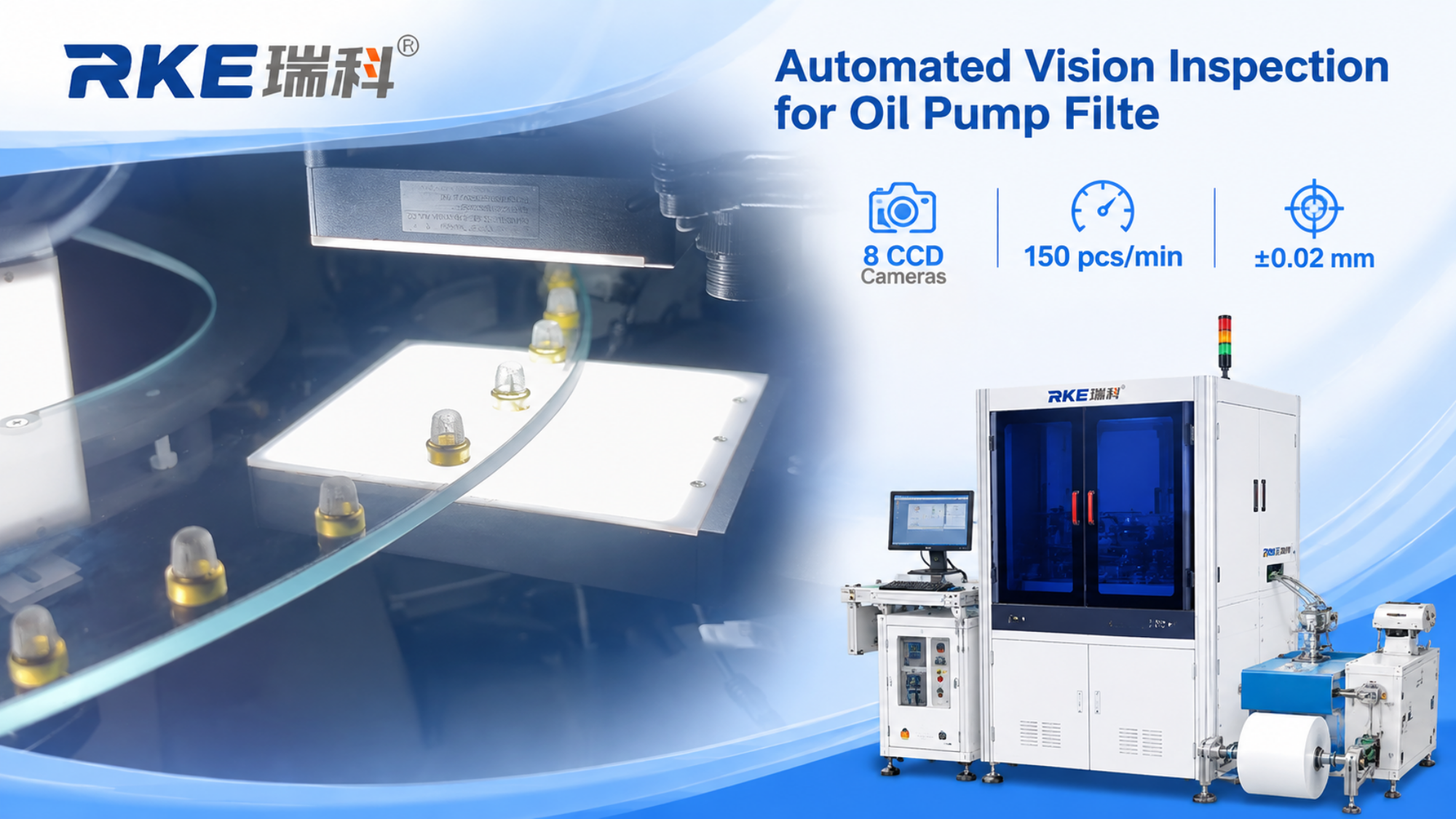
The demonstrated solution supports an inspection speed of up to 150 pcs/min. It automates image capture, defect judgment, and part sorting. As a result, manufacturers can reduce repetitive manual checks and improve production efficiency. The system also supports recipe-based product changeover for similar filter models.
3. Customized Inspection for Different Products
Different oil pump filters have different shapes, mesh structures, and inspection requirements. For this reason, RKE customizes feeding tracks, fixtures, camera positions, lighting, and inspection algorithms. Customers can also provide drawings and samples to help define the inspection solution.
4. Traceable Inspection Data
The system records production counts, defect statistics, and inspection images. In addition, customers can export data through CSV or Excel files. These records help quality teams review inspection results and prepare customer audit reports. RKE can also discuss MES or ERP integration for digital production management.
Technical Specifications
| Item | Specification |
|---|---|
| Inspection accuracy | ±0.02 mm |
| Inspection speed | Up to 150 pcs/min |
| Camera system | 8 CCD industrial cameras |
| Lighting | LED backlight + coaxial/dome combination lighting |
| Defect detection | Dimensions, deformation, burrs, broken mesh, contamination, surface defects |
| Rejection method | Air nozzle / robotic finger sorting |
| Sorting output | OK/NG bins |
| Data output | Production counts, defect statistics, inspection images |
| Data export | CSV / Excel; MES integration available |
| Power supply | AC 220V, 50/60 Hz |
| Optional functions | Custom feeding, multi-station imaging, code reading, packing integration |
Industries and Applications
The RKE oil pump filter inspection solution serves manufacturers of small metal filtration components. In addition, the same vision inspection technology can support other precision components.
Typical applications include:
Automotive components: Oil pump filters, relief valve filter screens, and strainers.
Automotive precision parts: Shafts, bushings, O-ring seals, and stamped components.
Filtration products: Metal mesh filters, sintered filters, and fuel filter caps.
Industrial hardware: Brass inserts, threaded fittings, and spring components.
If your factory produces small metal or plastic parts in large quantities, automated visual sorting may help improve your quality control process.
Frequently Asked Questions
1. What inspection accuracy can the oil pump filter sorting machine achieve?
The demonstrated machine provides an inspection accuracy of ±0.02 mm. However, actual performance depends on the component size, material, and measured feature. RKE recommends sample testing before confirming the final specifications.
2. Can the machine detect burrs and broken filter mesh?
Yes. The system can inspect burrs, broken mesh strands, missing mesh sections, and mesh displacement. It combines backlight imaging with AI-assisted inspection to identify these defects. Customers can also provide defect samples to help configure the inspection criteria.
3. Can RKE customize the machine for different oil pump filter designs?
Yes. RKE can customize the feeding system, fixtures, camera stations, lighting, and inspection algorithms. First, our team reviews your product drawings and samples. Then, we recommend a suitable inspection configuration. The system can also support multiple product models through recipe changeover.
4. Can the machine export inspection data?
Yes. The system records production counts, defect statistics, and inspection images. Customers can export inspection reports through CSV or Excel files. Furthermore, RKE can discuss MES or ERP integration for factory digitalization projects.
5. Does RKE provide sample testing before purchase?
Yes. RKE provides free sample testing for project evaluation. Send us your oil pump filter samples, including known defective parts if available. Our team will evaluate the inspection requirements and provide test results with inspection images. This process helps you understand the proposed inspection solution before making a decision.
Improving Oil Pump Filter Quality Control with Automated Vision Inspection
Reliable oil pump filter inspection requires accurate measurement, consistent defect detection, and effective production management. RKE combines 8 CCD industrial cameras, AI-assisted inspection software, and automated sorting technology to help manufacturers improve quality control.
The demonstrated solution reaches up to 150 pcs/min with a stated accuracy of ±0.02 mm. Moreover, RKE can customize the inspection configuration according to product dimensions, defect types, and customer quality standards.
For manufacturers looking to improve oil pump filter inspection, RKE welcomes product samples, photos, and technical drawings for application evaluation and sample testing.